
Touch Grass
One day we will all touch grass

I.
Taxi Driver documents the life of a particular Travis Bickle, a veteran of the much-maligned war fought between the USA and Vietnam, in a New York City far removed from the post-Guiliani darling jewel of the American East Coast and, arguably, pop culture at large. The New York in Martin Scorcese’s Taxi Driver is grotesque, grimy and morally bankrupt—or so we are led to believe by our humble narrator, Travis, who drives a taxicab after dark with a keen and observational eye. Travis is something of a pervesion of the hero trope; and an ominous precedent in our age of liquid post-modernity and slippery meaning.
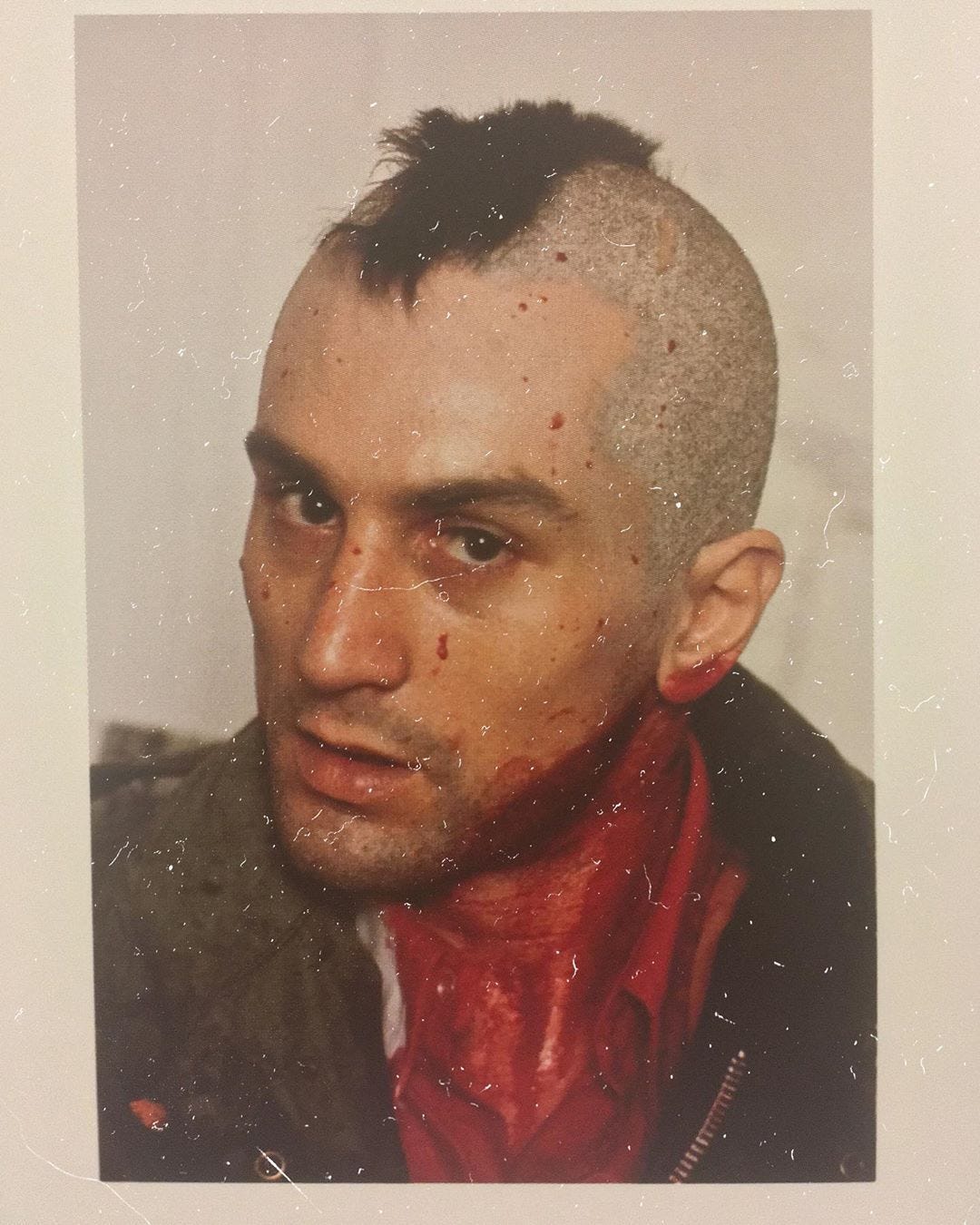
The film’s neo-noir, quasi-Western feel serves to illustrate the duality of Travis Bickle’s cultural logic as a character. On one hand, he is a figure of brute, albeit contained, masculinity operating within the binary logic of good and evil— and so it happens that we often meet Travis as he meets the world: through his windshield, in a position of feigned omniscience, describing evil and how it revolts him. It is within this binary that he we come to interact with his basic desire to become ‘a person like other people’—a meaningful part of a social unit that has ultimately alienated him; a hero. That this is only ever realised as a project of personal individuation frames him as something of a cultural catch-22—a man who fundamentally seeks out the hero myth, but afforded with little means to do so, constructs his narrative through violent, illegitimate means. After meeting a child prostitute, Travis becomes engrossed with the idea that he can redeem the world through self-abnegation. He kills the pimp of a child prostitute and lies smirking through the torrent of his own (and his victim’s) blood. The world is saved, and safe to go on as it did before—the meaning, if there ever was one, fades into black.
II.
I commute to work twice per week, almost always on Mondays and Thursdays. Of the 30-odd minutes I spend in transit between my home and the office, at least 17 of these minutes will be spent in Warsaw’s metro1. In a given week, that amounts to a little over an hour sat in a metal box with nothing else to do except trust that I will arrive at my destination on time, in one piece. Fellow residents of Warsaw, I imagine, have similar thoughts. I’ve gone through entire tomes of literature during this time, Dostoevsky’s Crime and Punishment comes to mind as a meaningful commute read I managed to get through in transit. Susan Sontag’s On Photography as well. Recently I’ve been working through Oswald Spengler and Dostoevsky (again), depending on the mood. When I can’t be bothered, then nothing at all—preferring to remain frazzled after a barrage of emails at the end of a rather long working day.
Those moments of quiet afforded to me by the relative comfort of public transport are precious. For a few fleeting moments, I am responsible for almost nothing at all except keeping my balance to prevent myself from falling onto an elderly lady or someone else just as fragile (if I’m standing). I also get to observe The Masses™ scrolling away. Some half-click and scroll through some tendentious clickbaity article. Others jolt through one context-devoid video after another at breakneck speed (sometimes with the volume on full blast, as if noone else were around them). I want to sometimes bash the head of the scroller nearest to me.
"Don’t you fucking get it man?"
We all kind of do, implicitly. We know we’re mined for data and that it’s subsequently sold for profit. ‘If you don’t know what they’re selling then you’re the product’ and all of that nonsense. I’m getting at something I’ve said many times over, and that has probably been said by minds brighter and much more sensitive than I could ever hope to be. The spectacle is rotting your soul to the core2. You’ve got to get offline, but I mean completely off grid dude—outside of the consumer complex.
III.
I’m writing this under warm lighting, in the bosom of corporate comfort having never seen Nina Kraviz3 live, but she’s made manifest in my headset. There are scintillating highs on offer for the enlightened seeker, and at that level of unmediated intimacy with the other as an event of collapsed ontological boundaries, one might become something other than themselves and remain that way for a brief spell afterwards. That’s the real crux and issue of a comedown; physiological concerns being shoved aside for their purely causal nature4. It’s a Faustian bargain where nothing is saved at all, not even ourselves.
If there’s an express purpose to all of the above, is that you will positively die at the end of it all. There is much interminable dread to encounter as a subject bereft of agency, in a mediascape hell-bent on its own existence as a matter of principle, nay, telos in which we play a fractious part. If it’s easier to imagine the end of the world instead of the end of capitalism, it’s because we’re functionally impotent as far as our imaginative capacities are concerned, borrowing from the same revolutionary tropes that are a functional image of a progress we cannot meaningfully reify through any kind of praxis, real or imagined.
The way out? Touching grass. Grass everywhere, actively seeking grass. First thing in the morning? Grass. Before bed? Grass. Making love on a grassy meadow. Eating grass fed beef bereft of texture. Eating grass itself. Abandoning all poetry and attempts at metaphor for grass. Extending grass through the barely-soundproofed walling in your overpriced 32m2 flat to a neighbour as a quasi-peace offering cum invitation to the grass utopia. A horseness is a whatness, grass is a grassness, and all that jazz. At the end of capitalism (lmao) a vast expanse of it awaits. Wander there, you condemned.
That’s for one leg of the journey, by the way.
https://www.marxists.org/reference/archive/debord/society.htm
Quite a few cultures would be a sworn enemy of causal thinking. I will not explain this any further.
Excuse me, waiter. There's too much grass in my grass burger.
Another good one Donell.